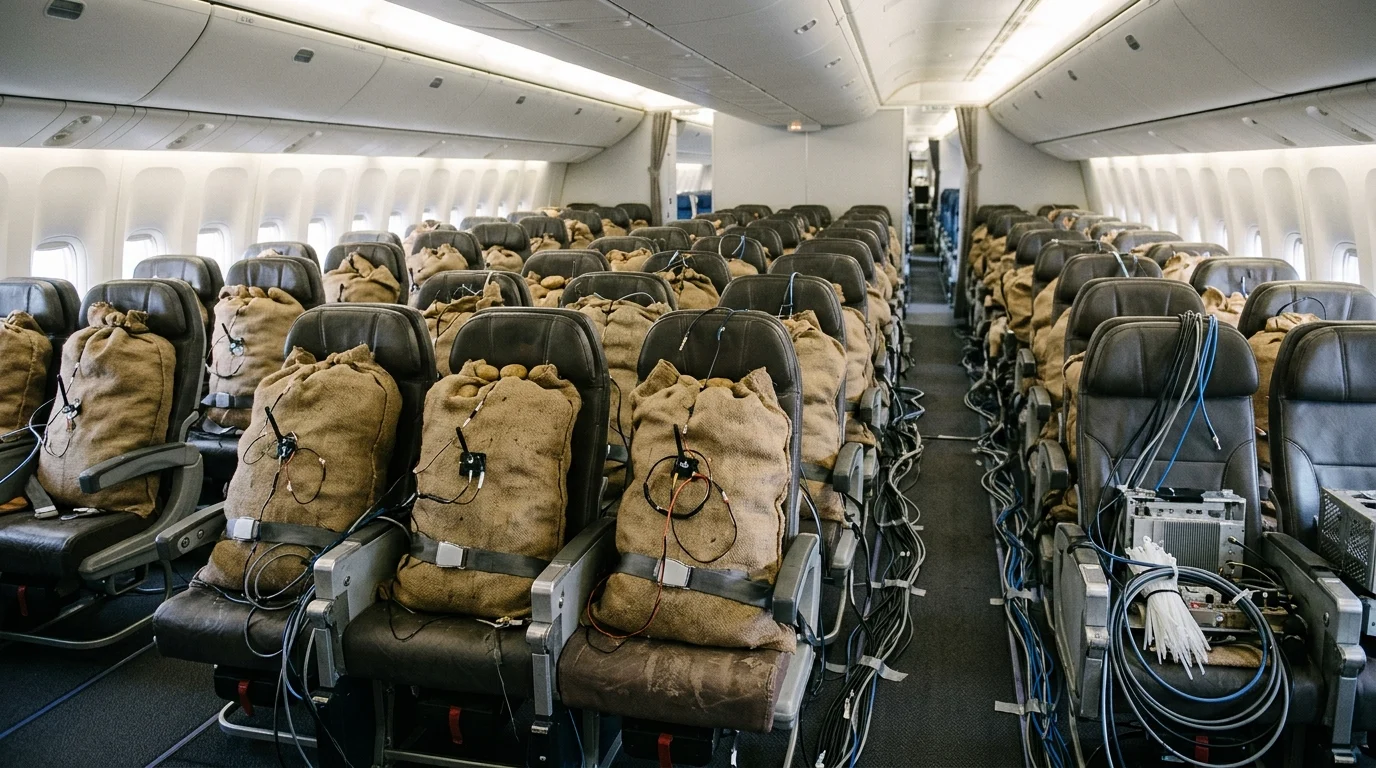
Perché Boeing carica 9 tonnellate di patate per testare il Wi-Fi
Formazione in ingegneria meccanica al Politecnico di Torino; specializzato in propulsione aeronautica, segnalamento ferroviario e dinamica dei veicoli.
Informazioni sull’autore
Formatosi in ingegneria meccanica al Politecnico di Torino prima di dedicarsi al giornalismo tecnico, Lorenzo Ferraris racconta perché aerei, treni ad alta velocità, navi e automobili sono progettati in un certo modo: dalle rotte oceaniche ETOPS e le leghe di titanio aeronautico fino ai sistemi di segnalamento ferroviario europeo ERTMS/LZB e alla fisica dei cambi meccanici. Lavora direttamente sui rapporti d'inchiesta ANSV, EASA e NTSB, sulle direttive di aeronavigabilità, sui brevetti industriali e sui manuali operativi dei costruttori.
- Sacchi di patate imbarcati
- 20.000 lb
- Massa totale distribuita sui sedili dell'aereo dismesso nei test a terra del 2012[1]
- Durata della calibrazione
- 10 ore
- Tempo di test con il metodo SPUDS contro le oltre due settimane precedenti[3]
- Acqua nelle patate crude
- 79,5%–83,3%
- Umidità su base umida misurata tra 300 e 3.000 MHz nei campioni dielettrici[4]
Salta a una sezione
Il paradosso della fusoliera: perché un aereo pieno uccide il segnale
Il protocollo SPUDS: 20.000 libbre di tuberi al posto dei volontari
200 sedili
La fisica dielettrica: perché una patata imita il tessuto umano a 2,4 GHz

Further reading · Trasporti e Macchine
Perché scendere in folle consuma più carburante della marcia
- Costante dielettrica relativa ($\varepsilon'$): misura la capacità del mezzo biologico di immagazzinare energia elettrica quando viene attraversato dal campo radio.[14]
- Fattore di perdita dielettrica ($\varepsilon''$): quantifica la quota di energia elettromagnetica che il materiale assorbe e dissipa sotto forma di calore.[14]
- Rilassamento dipolare e conduzione ionica: nei materiali con umidità superiore al 35%–40%, l'acqua libera domina la risposta complessiva; sotto i 300 MHz prevale la conduzione ionica dei sali, mentre alle frequenze microonde del Wi-Fi governa la polarizzazione dei dipoli d'acqua.[16][17]
Non solo film in streaming: i vincoli di sicurezza FAA e lo standard RTCA/DO-307A
Domande frequenti
Perché nel boeing test wifi patate si usano proprio i tuberi al posto delle persone?
Cosa significa la sigla SPUDS scelta dagli ingegneri Boeing?
Quante patate sono state caricate sull'aereo e quanto tempo ha fatto risparmiare il metodo?
Perché la cabina di un aereo di linea è così critica per la copertura Wi-Fi?
Quale meccanismo fisico governa l'assorbimento delle onde radio nelle patate?
I test con i sacchi di patate servono anche per la sicurezza del volo?
Per approfondire
Fonti
20 riferimenti Mostra Nascondi
- Boeing MediaRoom, 19 Dec 2012 (si apre in una nuova scheda)
«Much of the testing was conducted on the grounded airplane with the seats filled with 20,000 pounds of potato sacks.»
- Los Angeles Times, 19 Dec 2012 (si apre in una nuova scheda)
«The testing idea has been dubbed Synthetic Personnel Using Dielectric Substitution, or SPUDS.»
- Boeing MediaRoom, 19 Dec 2012 (si apre in una nuova scheda)
«Once the new method was established, testing that previously took more than two weeks to conduct was reduced to 10 hours.»
- Journal of Food Science (Guan, Cheng, Wang, Tang, 2004) (si apre in una nuova scheda)
«This agrees with the obser-vations reported by Pace and others (1968), who measured dielectric properties of raw potatoes (moisture content: 79.5% to 83.3%, wb) at 300, 1000, and 3000 MHz, respective-ly.»
- CBS News, 2012 (si apre in una nuova scheda)
«Kenneth Kirchoff, a Boeing engineer, explained, "The airplane is what we call a very reverberant environment, it means that the signal bounces around quite a bit because it's an aluminum airplane, so we want to make sure that it's bouncing correctly, so we get all the proper signal that we need."»
- Science & Vie (si apre in una nuova scheda)
«Un corps humain absorbe et réfléchit les ondes à 2,4 et 5 gigahertz, si bien qu’une cabine pleine brouille le signal autrement qu’une cabine vide.»
- Wired, 2012 (si apre in una nuova scheda)
«As things move around -- as people move and the galley carts are pushed up and down the aisles -- then those signal levels can change.»
- CBS News, 2012 (si apre in una nuova scheda)
«So we built potato people and we put them on the seats, in 200 seats or so, and measured the performance of Wi-Fi.»
- GeekWire, 19 Dec 2012 (si apre in una nuova scheda)
«The company’s test engineers used 20,000 pounds of potatoes as stand-ins for humans — placing multiple sacks on each seat — to test their new techniques inside a decommissioned plane on the ground.»
- Los Angeles Times, 19 Dec 2012 (si apre in una nuova scheda)
«The sacks of potatoes replicate the way human passengers reflect and absorb electronic signals, said Boeing spokesman Adam Tischler.»
- CBS News, 2012 (si apre in una nuova scheda)
«To get an entire 747 plane connected with an online system takes approximately 15 days, Kosh Harrinauth, operations manager of United, told CBS News travel editor Peter Greenberg.»
- Boeing MediaRoom, 19 Dec 2012 (si apre in una nuova scheda)
«The test data was then validated on the ground with human stand-ins for passengers.»
- CBS News, 2012 (si apre in una nuova scheda)
«Boeing engineer Dennis Lewis said, "The way potatoes and people interact with electromagnetic energy is very similar."»
- arXiv:2303.12518 (Dielectric characterisation of materials) (si apre in una nuova scheda)
«In this work, we explore various methods for the dielectric characterisation of materials over a wide frequency range (1 MHz to 20 GHz), to cover RF and microwave frequencies, as well as understand the impact of ingredients (e.g. salt, sugar) and temperature on free and bound water resonances.»
- Journal of Food Science (Guan, Cheng, Wang, Tang, 2004) (si apre in una nuova scheda)
«Dielectric properties of mashed potatoes relevant to microwave and radio-frequency (RF) pasteuriza-tion and sterilization processes were measured over 1 to 1800 MHz and 20 °C to 120 °C. Effects of moisture content (81.6% to 87.8%, wb) and salt content (0.8% to 2.8%, wb) were investigated.»
- Journal of Food Science (Guan, Cheng, Wang, Tang, 2004) (si apre in una nuova scheda)
«For food materials with moisture con-tents of 35% to 40% or above, the majority of water of foods is in the state of free form and is supposed to be the dominant component governing the overall dielectric behavior of»
- Scientific Reports (Nature, 2017) (si apre in una nuova scheda)
«Ionic conduction contributes mainly on dielectric loss at radio frequency range below 300 MHz, and dipole polarization plays a major role at microwave frequencies»
- Boeing MediaRoom, 19 Dec 2012 (si apre in una nuova scheda)
«This technology was first developed to more thoroughly and efficiently ensure that signal propagation met the regulatory safety standards that protect against interference with an aircraft's critical electrical systems.»
- FAA Advisory Circular AC 20-164A (si apre in una nuova scheda)
«RTCA/DO-307A establishes aircraft system immunity criteria and test methods for designing and demonstrating aircraft tolerance to potential electromagnetic interference from passenger and flightcrew PEDs.»
- FAA Advisory Circular AC 20-164A (si apre in una nuova scheda)
«When the type certification applicant intends to demonstrate PED tolerance in accordance with this AC, the applicant must demonstrate aircraft PED tolerance to intentional transmissions (section 3 of RTCA/DO-307A), and spurious emissions (section 4 of RTCA/DO-307A).»