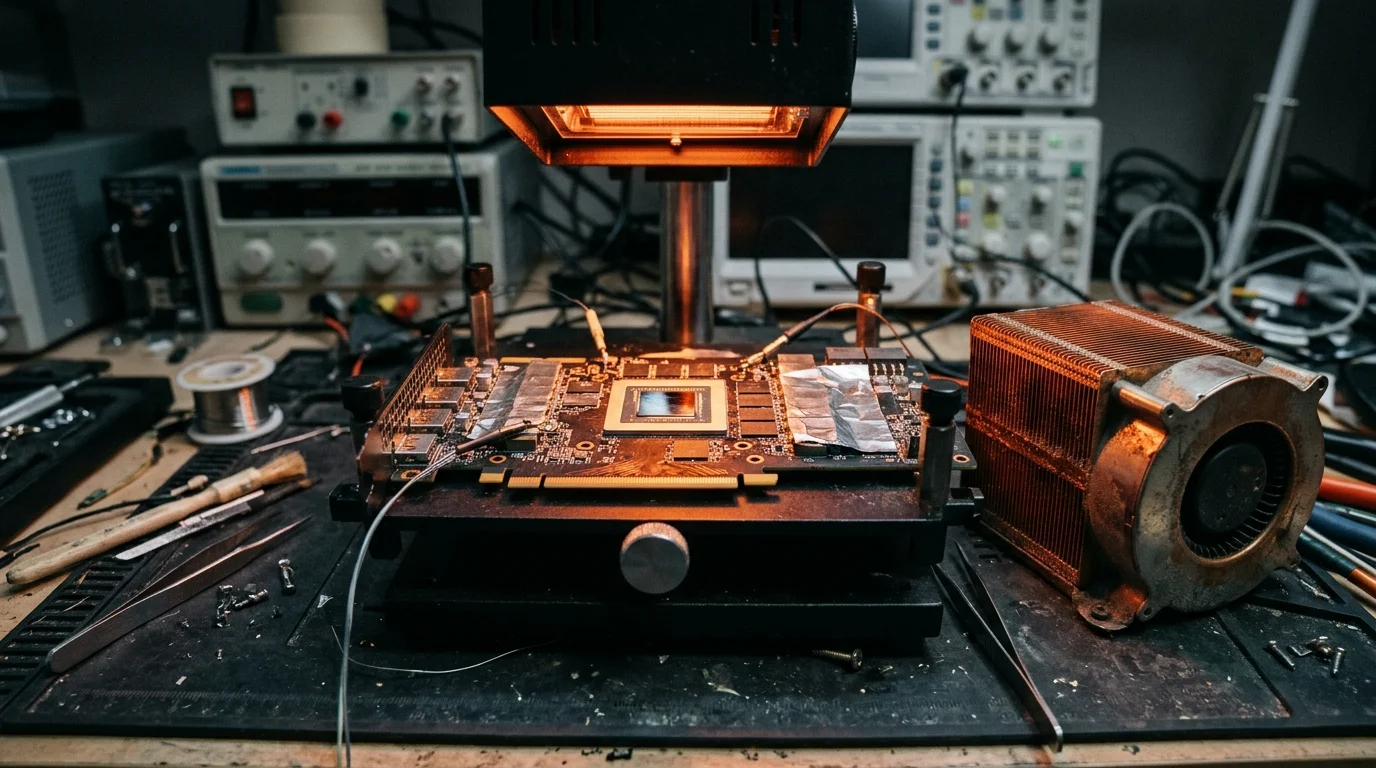
Perché in Cina dissaldano le RTX 5090 per farne server IA

Analista di sistemi e architetture hardware; segue litografia dei semiconduttori, data center, teardown di GPU, cavi sottomarini e software open source.
Informazioni sull’autore
Matteo Conti racconta il livello fisico e sistemistico dell'informatica: nodi litografici dei semiconduttori, smontaggio di GPU consumer riconvertite per cluster IA, bilancio termico dei data center, dorsali ottiche sottomarine e standard hardware come USB-C. Che si tratti di capire perché le fabbriche dissaldano i chip delle RTX 5090 per montarli su schede server o cosa succede quando una pubblica amministrazione abbandona i software proprietari, segue distinte base, consumi in watt, architetture di memoria e documentazione di sistema.
- VRAM e 3,4 PFLOPS in FP4
- 32 GB GDDR7
- Dotazione di memoria e potenza di calcolo IA della GeForce RTX 5090[5]
- Soglia export USA verso Cina
- 4.800 TPP
- Limite di Total Processing Performance fissato dal BIS nella norma 3A090[2]
- Ingombro dopo il trapianto
- 2 slot
- Spessore del PCB custom blower rispetto ai 3,5 slot dei modelli gaming[1]
Salta a una sezione
Il collo di bottiglia delle sanzioni USA e la metrica dei 4.800 TPP
5.286 TPP
Perché il silicio GB202 e 32 GB di GDDR7 fanno gola ai data center
Il limite fisico dei 3,5 slot e la termodinamica del dissipatore blower
Further reading · Energia e Reti Elettriche
Compensatori sincroni: i volani che salvano la rete elettrica
- Ingombro verticale ridotto a 2 slot: il passaggio da oltre 3,5 slot a un profilo rigorosamente dual-slot permette di impilare le schede negli slot PCIe adiacenti senza interferenze meccaniche.[1]
- Dissipatore blower a singola ventola centrifuga: i dissipatori gaming a tripla ventola scaricano il calore dentro il case, mentre una ventola radiale aspira aria fresca dall'interno del telaio, la spinge lungo l'intera lunghezza della scheda ed espelle l'aria rovente direttamente fuori dal pannello posteriore, evitando che il calore venga riciclato dalle GPU vicine.[14]
- Cablaggio posteriore 16-pin 12V-2x6: sulle schede convertite la presa di alimentazione a 16 pin (revisione dello standard 12VHPWR introdotto sulla serie 40) viene spostata sulla coda corta del PCB per facilitare l'inserimento dei cavi nei corridoi del rack.[1][15]
Dentro le fabbriche di conversione: dissaldatura BGA, PCB custom e collaudo
| Caratteristica | RTX 5090 Gaming Retail | RTX 5090 Server Blower |
|---|---|---|
| Spessore meccanico | 3,5 slot o superiore | 2 slot standard da rack |
| Sistema di raffreddamento | Multi-ventola assiale aperto | Singola ventola centrifuga radiale |
| Espulsione del calore | Ricircolo interno nello chassis | Scarico diretto dal retro |
| Posizione presa 16-pin | Lato lungo superiore | Coda posteriore del PCB |
Domande frequenti
Perché ci sono rtx 5090 smontate per server ia cina invece di montare le schede originali nei rack?
Qual è il limite imposto dagli Stati Uniti per l'esportazione di chip IA verso la Cina?
Come funziona la modifica hardware effettuata nelle fabbriche di conversione cinesi?
Che fine fanno i dissipatori originali e i PCB vuoti delle schede smontate?
È possibile portare la memoria della RTX 5090 oltre i 32 GB durante il trapianto?
Quali sono i vantaggi di una RTX 5090 rispetto alla RTX 4090 nei carichi di intelligenza artificiale?
Per approfondire
Fonti
15 riferimenti Mostra Nascondi
- Tom's Hardware — Blower-style RTX 5090D two-slot GPU design (si apre in una nuova scheda)
«You can see this with the rear placement of their 16-pin power connector and their smaller two-slot form factor (versus the larger 3.5 slots or larger that most third-party RTX 5090 GPUs take up), which makes installing and wiring many GPUs far more convenient.»
- U.S. Federal Register — BIS Implementation of Additional Export Controls (ECCN 3A090) (si apre in una nuova scheda)
«3A090 does not apply to items that are not designed or marketed for use in datacenters and do not have a `total processing performance' of 4800 or more.»
- Tom's Hardware — Chinese factories stripping RTX 5090s for AI servers (si apre in una nuova scheda)
«The recently leaked footage offers a glimpse inside these Chinese workshops, where skilled technicians meticulously desolder the pricey flagship’s GB202 silicon and GDDR7 memory chips. They then transplant the components into a dual-slot blower design tailored for server use.»
- Wccftech — Chinese factories dismantling GeForce GPUs for AI solutions (si apre in una nuova scheda)
«These PCBs and coolers are now being sold at really cheap prices, often for less than $50 US since the most valuable components, the AD102 GPU & GDDR6X memory, have already been taken apart.»
- Tom's Hardware — Nvidia GeForce RTX 5090 Review (si apre in una nuova scheda)
«With 32GB of VRAM and 3.4 PetaFLOPS of FP4 compute, it should easily eclipse any other consumer-centric GPU in AI workloads.»
- U.S. Federal Register — Definition of Total Processing Performance (TPP) (si apre in una nuova scheda)
«1. `Total processing performance' (`TPP') is 2 × `MacTOPS' × `bit length of the operation', aggregated over all processing units on the integrated circuit.»
- Tom's Hardware — US Govt restricts shipments of GeForce RTX 4090 (si apre in una nuova scheda)
«Starting from November 16, 2023, Nvidia will be unable to ship its A100, A800, H100, H800, L40, L40S, and GeForce RTX 4090 cards and modules for AI and HPC computing to China, Saudi Arabia, the United Arab Emirates, and Vietnam without an export license from the U.S. Department of Commerce's Bureau of Industry and Security.»
- Tom's Hardware — RTX 4090 and RTX 4090D TPP comparison (si apre in una nuova scheda)
«The RTX 4090 exceeded the 4,800 Total Processing Power (TPP) limit by 10%, and so Nvidia created the 4090D to come in below that limit (it lands at 4,707 TPP).»
- VideoCardz — GeForce RTX 5090D and parallel imports in China (si apre in una nuova scheda)
«The standard GeForce RTX 5090 is not meant to be sold through official China channels under current US export restrictions, so NVIDIA has leaned on China-specific GeForce RTX 5090D models instead. A later revision, GeForce RTX 5090D V2, was reported with 24GB of GDDR7 and a 384-bit bus as NVIDIA adjusted to changing rules.»
- VideoCardz — Massive RTX 5090 AI conversion factory exposed in China (si apre in una nuova scheda)
«The operation looks more like a proper graphics card production line than a typical modification workshop. Retail packaging and cards from several manufacturers can be seen, including PNY, Gigabyte, ASUS**, and even NVIDIA’s own Founders Edition.** Workers remove the original cooling systems before extracting the GPU and memory chips for use on custom PCBs.»
- Tom's Hardware — RTX 5090 GDDR7 memory bandwidth specifications (si apre in una nuova scheda)
«Just as important, it has 33% more VRAM than the 4090, and the GDDR7 runs 33% faster than the GDDR6X memory used on the 4090, yielding a 78% increase in memory bandwidth.»
- Tom's Hardware — GPU-Z verification of blower RTX 5090D (si apre in una nuova scheda)
«The video shared by Su-A computer on Bilibili also showed the card’s GPU-Z reading, proving that it uses the same GB202 chip with 32 GB of GDDR7 VRAM. It’s also equipped with PCIe 5.0 x16, ensuring the fastest possible transfer rates.»
- VideoCardz — VRAM modification limits on RTX 4090 vs RTX 5090 (si apre in una nuova scheda)
«In most cases, the interesting part **was the memory upgrade**, such as turning a 24GB RTX 4090 into a 48GB model. Those modifications were made possible partly by leaked NVIDIA configuration information for older GPU generations.»
- Tom's Hardware — Centrifugal blower fan cooling mechanics (si apre in una nuova scheda)
«These often have a single centrifugal fan that intakes cool air from inside the case and pushes it through the entire length of the GPU before expelling the hot air directly outside. This ensures that the heat generated by the GPU will not be recycled into the system, helping it run at a lower temperature.»
- Wikipedia — GeForce RTX 50 series technical specifications (si apre in una nuova scheda)
«The GeForce RTX 50 series uses the 16-pin 12V-2×6 connector, which is a revision of the 12VHPWR connector featured on earlier versions of the GeForce 40 series.»